
The Gobardhan Confessions
Manufactured Dissent and the Ethnic War on Memory in Suriname

Introduction: The Trauma of December 8
On December 8, 1982, fifteen prominent Surinamese intellectuals, unionists, and journalists were executed by the military regime of Desi Bouterse. These extrajudicial killings at Fort Zeelandia shocked the world, halted Dutch development aid, and marked the descent of Suriname into a reign of fear. One year later, the government orchestrated what appears to have been a full-scale propaganda campaign to reframe history, justify future repression, and strike preemptively against an emerging opposition. At the center of this operation was the Gobardhan family. This incident remains one of the least studied but most emblematic episodes of repression in postcolonial Suriname, particularly in its targeting of the Hindustani community.
The Gobardhan Family: From Dissidents to Scapegoats
The Bouterse regime accused multiple members of the Gobardhan family of participating in a complex coup plot designed to destabilize the country in stages: first, by sowing panic with pamphlets, then arson, then assassination, culminating in a mercenary invasion. In total, at least three Gobardhan brothers and a brother-in-law were arrested: Oumperkash, Krisnjapersad (Kries), and others, many of them from Nickerie, a Hindustani stronghold in West Suriname.
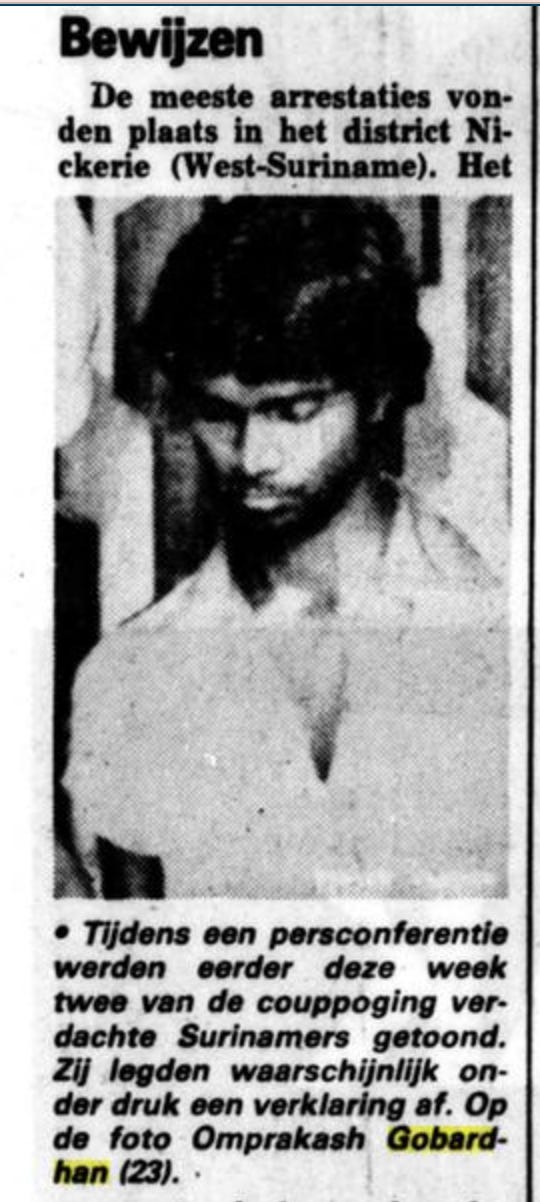
One of the brothers, Dennis Gobardhan, had previously been imprisoned in connection with the failed 1982 Rambocus coup. After fleeing to the Netherlands, he became a lightning rod for accusations from Bouterse's propaganda machine. While he denied sending money or instructions to his family, his name was repeatedly invoked by both military police and press officials. Notably, Omprakash Gobardhan, arrested in November 1983, confessed under pressure that he had received a phone call from Dennis instructing him to meet a courier in French Guiana and participate in the campaign of arson and destabilization.
Dennis's proximity to anti-regime networks was real. He had ties to Salem Somohardjo, a former parliamentarian and alleged operations leader within the Council for the Liberation of Suriname (CLS). According to Surinamese military police and intelligence reports, the CLS maintained not just diplomatic efforts abroad but an active 'operations division,' including affiliates like Kasi, Bottse, Doerga, and Gobardhan, many of whom had served time or been exiled following the 1982 coup attempt.
Whether Dennis was personally involved in planning an armed insurrection remains speculative. But within Bouterse’s calculus, his public dissidence, his family ties in Suriname, and his post-1982 exile status placed him at the symbolic heart of a feared diasporic threat. For a regime already primed to see every December 8 commemoration as an act of treason, that was enough.
Other family members arrested included R. Bekaroe, a brother-in-law, and younger brother Krisjnapersad, who was reportedly bloodied and bruised when his sister-in-law saw him post-arrest. Reports confirm he had injuries to the head and stomach, with eyewitnesses describing him as unrecognizable.
The Alleged Coup: Pamphlets, Petrol, and Phantom Invasions
According to the Surinamese military police, the coup was to unfold in phases:
Phase 1: Distribution of anti-regime pamphlets
Phase 2: Arson at symbolic institutions (SRS radio, Ministry of Labor, a HAVO school)
Phase 3: Targeted assassinations from a "death list"
Phase 4: Mercenary invasion from French Guiana
Oumperkash Gobardhan was filmed during a government-staged press conference, stating that he had been contacted by his brother Dennis from the Netherlands, met a courier in French Guiana, and was given 1,000 guilders and a list of names to eliminate. The event was choreographed by Sergeant Major Zeeuw, who interrupted Gobardhan mid-statement and prohibited journalists from asking questions.
Karel Lindveld, a self-described sniper, was presented alongside Gobardhan and said he had been assigned to provide armed cover during arsons. Lindveld’s role was to shoot down any military resistance without hesitation.
Despite the gravity of the accusations, journalists on the ground were not allowed to ask questions. Most international observers suspected that the confessions were coerced. This view was reinforced when parallels were drawn to earlier coerced statements made by dissidents shortly before their execution.
Televised Terror and the Theater of Confession
The televised confessions of Oumperkash and Lindveld bore an uncanny resemblance to those of 1982. They were cut short, media was restricted, and the emotional state of the suspects signaled duress. Dutch correspondents on the ground, including Peter Schumacher of NRC Handelsblad, noted widespread public disbelief. The Liberation Council, led in exile by Henk Chin A Sen, denied all involvement, calling the event a "fabrication of the regime."
The National Information Service claimed more evidence would follow, yet no concrete proof of a coup emerged. Instead, the regime had what it wanted: a televised justification to detain, interrogate, and silence a perceived ethnic opposition.
Ethnic Targeting and the Diaspora Link
The Gobardhans were not alone. 69 people were arrested, most of them Hindustani, many from Nickerie, and several with relatives in the Netherlands known to oppose the regime. In multiple districts, entire families were reportedly taken from their homes in the middle of the night. Many were flown to Paramaribo for questioning. Consular access was denied in numerous cases, and abuse during interrogations was common.
Diaspora voices like Radjendre Ramnat of the Eekta Federation in The Hague condemned the repression, noting that Bouterse's crackdown was intended to stop planned December 8 commemorations and suppress Hindustani resistance. “The initiative is a local affair,” said Ramnat. “But the regime has chosen to tie it to foreign conspiracies.”
Other diaspora leaders and exiles, including Liberation Council spokesman Ir. A. Sewradsingh, directly disputed the official narrative, calling the allegations a pattern of disinformation. He highlighted how previous confessions had been extracted under threat of torture or execution, and reaffirmed that resistance efforts had been primarily informational—centered on literature, radio transmissions, and memorial organizing, not armed insurrection.
Still, it is clear that the regime did not invent its fears from whole cloth. The remnants of the Rambocus network, combined with embittered exiles and anti-Bouterse activists in the Netherlands, presented a persistent symbolic threat. Whether or not the Council for the Liberation of Suriname ever intended armed insurrection, Bouterse's regime perceived them as capable of it—and acted accordingly.
Conclusions: Memory as a Battlefield
By late 1983, Desi Bouterse's government was not just fighting against armed threats—it was fighting against memory. The Gobardhan affair shows how false flag narratives, ethnic scapegoating, and stage-managed confessions were used to seize control of the public narrative and destroy the capacity to mourn. Just as the December murders attempted to decapitate the intellectual leadership of the opposition, the 1983 coup hoax sought to criminalize remembrance itself.
In a sense, the Gobardhans were punished not for what they did, but for who they were: symbols of a memory the regime could not erase.
Citations:
De Volkskrant. “Resistance among Hindustanis in Suriname Is Growing.” December 2, 1983.
Het Parool. “Arrest of ‘Putschists’ in Suriname.” November 30, 1983.
Trouw. “Suriname Army Prevents ‘Mercenary Invasion.’” November 11, 1983.
NRC Handelsblad. “Bekentenis: Betaald Voor Brandstichting.” November 30, 1983.
Nederlands Dagblad. “Liberation Council Suriname: Coup Attempt Pure Fabrication.” December 1, 1983.
De Waarheid. “Assault during Arrest in Paramaribo.” November 30, 1983.
Trouw. “Paramaribo Arrests 69 People.” January 12, 1984.
De Telegraaf. “Rambocus Had Suriname in Handen, Maar Wilde Geen Bloed Vergieten.” January 15, 1983.
De Volkskrant. “In Connec
Citations:
De Volkskrant. “Resistance among Hindustanis in Suriname Is Growing.” December 2, 1983.
Het Parool. “Arrest of ‘Putschists’ in Suriname.” November 30, 1983.
Trouw. “Suriname Army Prevents ‘Mercenary Invasion.’” November 11, 1983.
NRC Handelsblad. “Bekentenis: Betaald Voor Brandstichting.” November 30, 1983.
Nederlands Dagblad. “Liberation Council Suriname: Coup Attempt Pure Fabrication.” December 1, 1983.
De Waarheid. “Assault during Arrest in Paramaribo.” November 30, 1983.
Trouw. “Paramaribo Arrests 69 People.” January 12, 1984.
De Telegraaf. “Rambocus Had Suriname in Handen, Maar Wilde Geen Bloed Vergieten.” January 15, 1983.
De Volkskrant. “In Connection with Frozen Coup: Number of Arrests in Suriname Increases.” January 12, 1984.
Het Parool. “Manhunt for Hindustanis in Suriname.” November 29, 1983.
De Volkskrant. “Assault during Arrest in Paramaribo.” November 30, 1983.
NRC Handelsblad. “Dutchman Wanted to Burn Down City, Says Paramaribo.” December 7, 1983.
Nieuwsblad van het Noorden. “Protest Suriname Bij Den Haag En Parijs.” December 1, 1983.
NRC Handelsblad. “Bouterse Looking for a House in New York.” November 30, 1983.