
The Paper Trail
How a Single Document Rewrites Everything We Know About U.S. Policy in Suriname

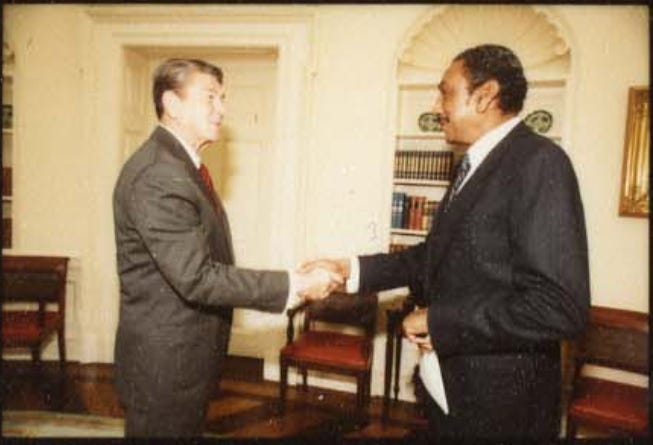
TL;DR: Documents from Reagan Archives Expose Project Democracy's Covert Playbook
Newly uncovered Reagan Library documents reveal how Project Democracy's architects—Oliver North, Robert McFarlane, and Constantine Menges—coordinated both overt diplomacy and covert action in Suriname. Private contractor Carlos Collins’s intervention proposals, citing failed coups, reached high-level NSC officials and the president, showing serious consideration of his services. Meanwhile, Surinamese ambassador Donald McLeod’s 1984 appointment was vetted through NSC channels rather than standard State Department procedures, with North and Menges directly involved. These records expose Suriname as a testing ground for Project Democracy's covert playbook, blending private actors, diplomatic appointments, and shadow operations into a strategy later replicated in Nicaragua.
The Christmas Eve Discovery
Sometimes history has a sense of irony. On Christmas Eve 2024, as I was putting the finishing touches on my investigation of Peter van Haperen's alleged "Red Christmas" coup plot in Suriname, a message arrived from my research partner, Sander Peeters. We exchanged holiday wishes, and I sent him a preview of my latest findings about van Haperen's role in the failed 1982 operation.
What Sander sent back would finally provide the documentary proof connecting van Haperen's failed coup to Project Democracy. Among his discoveries in the Reagan Presidential Library was a letter from Henk Chin A Sen - but it was another document, a simple routing slip, that stopped me in my tracks. After years of tracking mercenary networks and piecing together declassified cables, here was evidence showing how the same officials who managed van Haperen's operation were directly involved in vetting Suriname's diplomats.
The next morning, as news broke of Russia's Christmas invasion of Ukraine, another message from Sander landed: Desi Bouterse, the man at the center of our investigation who had been evading arrest since early 2024, had died in hiding. The timing felt almost scripted - here I was, investigating a Christmas coup plot from four decades ago, while current events seemed to echo through time.
But it was that routing slip that kept drawing my attention back. Three names jumped out from the bureaucratic form: Robert McFarlane, Constantine Menges, and Oliver North. In that moment, everything we'd uncovered about van Haperen, Operation Guiminish, and Project Democracy clicked into place. The document wasn't just a piece of paper - it was the thread that connected every aspect of America's secret war in Suriname.
This is the story of how a Christmas Eve email exchange led to the discovery that would rewrite everything we thought we knew about U.S. policy in the Caribbean. It begins with a single question: Why would the architects of Iran-Contra be involved in vetting Suriname's ambassador in 1984?
The Private Contractor's Proposal
By late 1983, the path for private citizens to influence Reagan's foreign policy had already been blazed. Jack Wheeler, "The Indiana Jones of the Right," had spent six months documenting anti-Soviet movements in Nicaragua, Afghanistan, and Angola. In November, he stood before CIA, NSC, and White House staff in the Old Executive Office Building, spreading photos across the table and painting a vision of worldwide rebellion. Through his friendship with Dana Rohrabacher and Oliver North, Wheeler's radical notion of destabilization from within was helping shape what would become the Reagan Doctrine.
Wheeler's Freedom Research Foundation created a template for private operators to frame their proposals within Cold War strategy. His articles about "Robin Hood Commandos" and briefings to CIA Director Casey were redefining how the administration viewed private anti-communist initiatives. When he later turned up in French Guiana working with Henk Chin A Sen and advising the "The Black Robin Hood" himself, it was clear his influence extended beyond mere rhetoric.
Setting the Stage: Wheeler's Blueprint
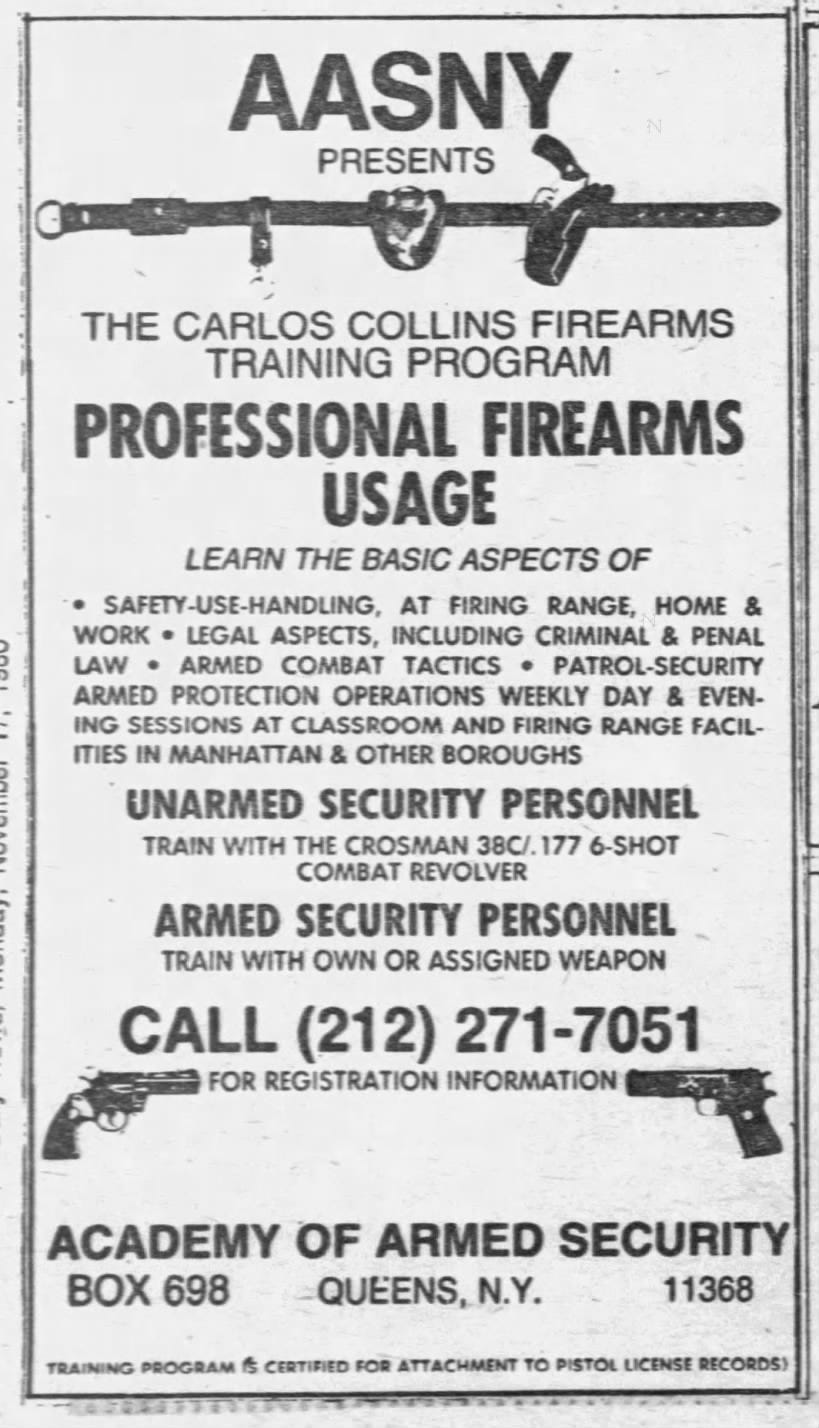
It was in this context that the extraordinary sequence of events began in the summer of 1983. Carlos Collins, director of a little-known New York security company called the Academy of Armed Security, Patrol, and Investigative Tactics (AASNY), attempted something that might have seemed outlandish if Wheeler hadn't already blazed the trail: proposing private security solutions for U.S. interests in Suriname.
Collins's approach was methodical. He first sent a newspaper clipping of Harrison Rainie's article in the Daily News (June 2, 1983) about Reagan having been rebuffed by Congress in his attempt to use the CIA to topple Desi Bouterse. Collin’s included credentials seemed tailored to the moment: military service in the U.S. Air Force, law enforcement experience, and expertise in nuclear security. In follow-up letters, growing more urgent with each unanswered appeal, he emphasized his conservative, anti-leftist leanings - clear signals of ideological alignment with Reagan's Cold War vision. When that letter failed to receive the timely response hoped for, Carlos sent clippings of the botched van Haperen operation and the Council for Liberation of Suriname's failed initiatives, to Jeanne Hyde of the Agency Liaison Office, positioning his organization as a more reliable alternative. He included an article by Jerry Schmetterer, about how cops find "fixed assignments" guarding "diplomatic missions and other sensitive areas" undesirable.
The Path to Reagan's Desk
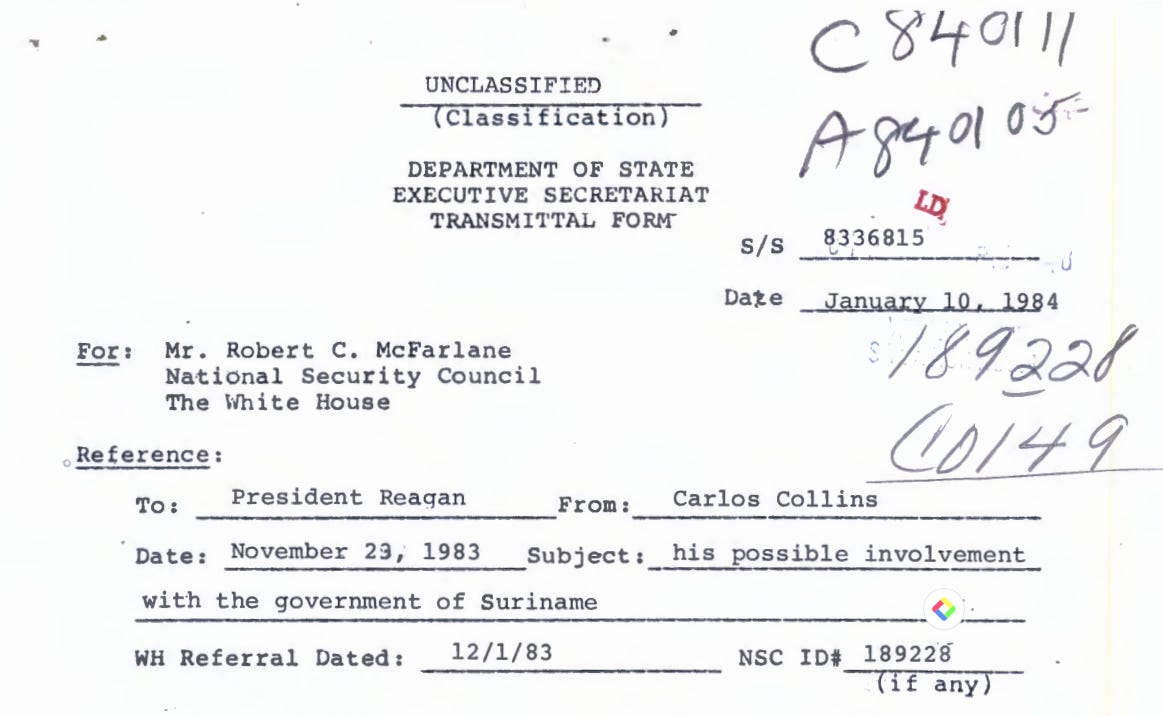
What makes these letters more than just an ambitious pitch was their extraordinary journey through the U.S. bureaucracy. The document trail tells a story that directly challenges later Iran-Contra testimony. A Department of State Executive Secretariat Transmittal Form dated January 10, 1984, shows that Carlos Collins's proposal about "his possible involvement with the government of Suriname" wasn't just reaching mid-level bureaucrats - it was being routed explicitly "To: President Reagan."
This routing is crucial. During the Iran-Contra hearings, Reagan would famously claim he knew nothing about North's covert operations. Yet here we have documentary evidence that similar private operational proposals were being tracked through formal White House channels, complete with NSC ID numbers (189228) and White House referral dates (12/1/83). The document bears Charles Hill's signature as Executive Secretary and is addressed to Robert McFarlane at the National Security Council - the same McFarlane who would later become a central figure in Iran-Contra.
Most intriguingly, Collins claimed direct contact with Surinamese government representatives, suggesting his services were being sought by both sides of the conflict. His Academy of Armed Security offered a range of services that aligned suspiciously well with U.S. interests: embassy protection, nuclear facility security consulting, and notably, "possible involvement with the government of Suriname."
The documents from this period reveal how direct appeals from private citizens could reach not just the National Security Council, but the President himself, when they aligned with Project Democracy's objectives. Collins's proposal arrived just as the NSC was exploring options for intervention in Suriname. Within two years, another private contractor with similar credentials - Tommy Lynn Denley - would emerge leading a coup attempt in support of Council-backed Ronnie Brunswijk, suggesting Collins's approach was less anomalous than it first appeared. The paper trail showing Collins's proposal reaching Reagan's desk helps explain why: these weren't just random pitches from adventurers - they were being seriously evaluated at the highest levels of government.
The Pivot to Sophisticated Control
While Collins's proposal was working its way through NSC channels, events on the ground were forcing Project Democracy's architects to rethink their approach. In January 1984, the Council for Liberation of Suriname reached out to Dr. John Charles McClure, fresh from serving in Eden Pastora's forces. The million-dollar price tag for his services proved too steep, but the contact itself revealed the Council's continued pursuit of military options even as diplomatic channels were being explored.
The timing was significant. Suriname's economy was deteriorating, with bauxite workers on strike. Ronnie Brunswijk, Bouterse's former bodyguard who had been denied a raise, remained at large as a suspect in an armed bank robbery. Meanwhile, the remnants of Peter van Haperen's operation - Roy Bottse, Chris Mahabier, Hardley "Dino" Lie-A-Tjam, Glenn Tjon-A-Kiet, and Romeo Hoost - were expelled from French Guiana after another failed coup attempt orchestrated by Dr. John and the Council. McClure's subsequent suspicion that the Council was using the event as a publicity stunt and fundraiser highlighted the growing complexity of these operations.
On March 2, 1984, just weeks before McLeod's appointment would trigger NSC scrutiny, Lt. Col. Oliver North and Constantine Menges wrote their now-infamous top-secret action memorandum to Robert McFarlane about CIA economic sabotage and mine warfare in Nicaragua.1 The same officials who would carefully vet Suriname's choice of ambassador were simultaneously coordinating direct action elsewhere in the region.
This convergence of events - failed military operations, economic deterioration, and the parallel development of sophisticated control mechanisms - helps explain why McLeod's appointment would receive such careful attention from Project Democracy's architects. The routing slip that crossed Reagan's desk wasn't just about a diplomatic posting - it was evidence of a strategic pivot.
The Secret Architecture of Project Democracy
By April 1984, the tension between sophisticated control and direct action that would define Project Democracy was playing out through an unlikely channel: the appointment of Suriname's new ambassador to Washington.
The Violet Plan, unveiled by NSC staffers Frederick Wettering and Constantine Menges just months earlier, had promised a new approach.2 Instead of backing mercenary invasions like the failed Council operations that embarrassed the administration throughout 1983, it called for coordinated economic, political, and covert pressure to engineer democratic transitions. The day after this sophisticated strategy was outlined, Bouterse announced yet another failed Council-backed coup attempt - a stark reminder of why change was needed.34
The Violet Plan Takes Shape
But a simple routing slip, recently discovered in the Ronald Reagan Presidential Library, reveals how difficult this transition would be. When Suriname's Foreign Ministry requested approval for Donald Aloysius McLeod as their new ambassador in April 1984, the seemingly routine diplomatic matter triggered unusual scrutiny. The document shows McLeod's appointment being vetted by the very architects of Project Democracy: Constantine Menges and Oliver North. For these officials - better known for their later role in Iran-Contra - to scrutinize an ambassadorial appointment was extraordinary.
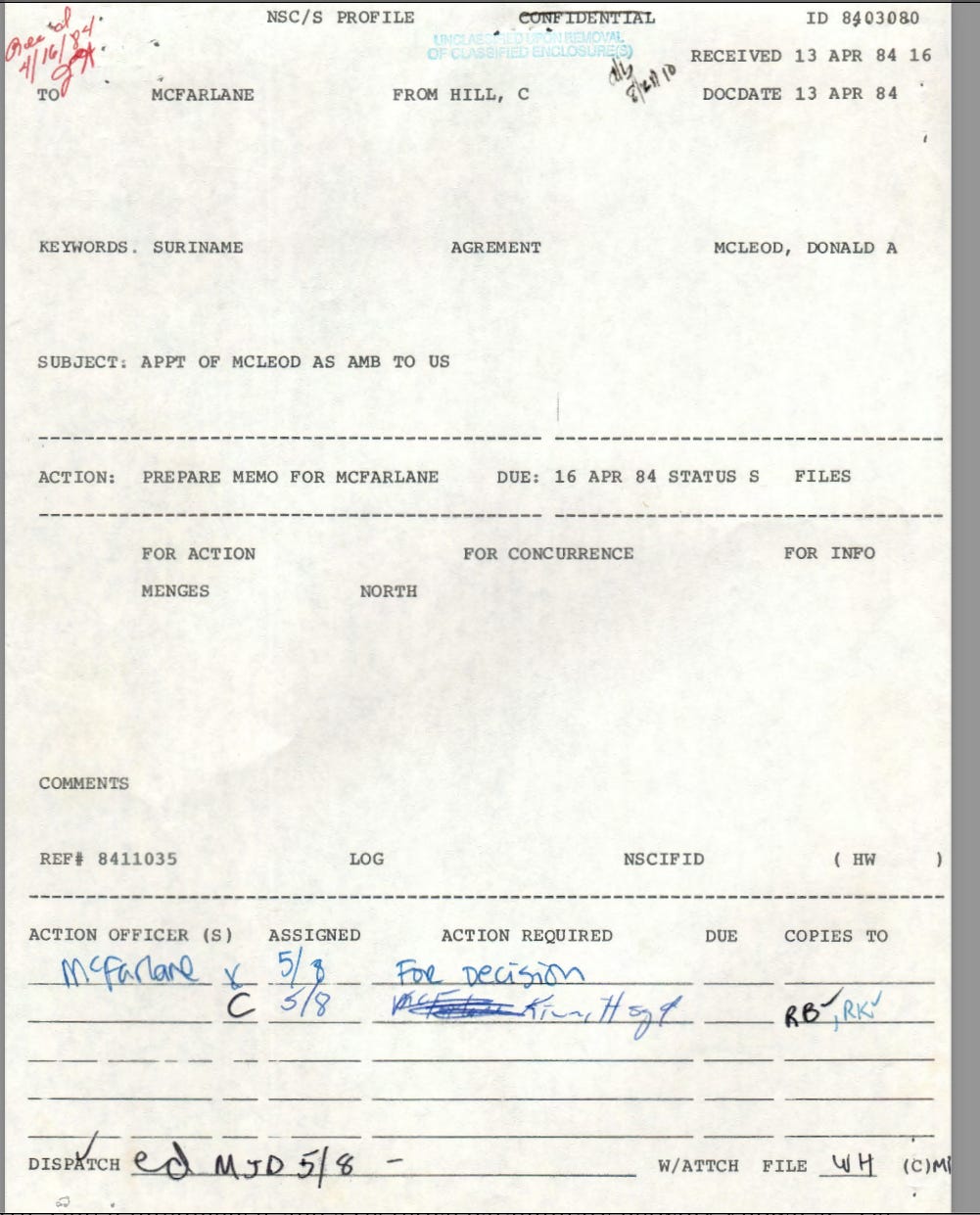
The U.S. Embassy's cable about McLeod raised intriguing points. Born in Curaçao rather than Suriname, questions lingered about his citizenship. He had spent the previous five and a half years stationed abroad, becoming an "infrequent visitor to Paramaribo." Though "not known to Embassy," he maintained a "good reputation" in Suriname's capital. His multilingual abilities - English, Dutch, Spanish, and French - and his careful distance from local politics made him an unusual choice for a military government typically suspicious of Western-oriented diplomats.
To understand why finding these three names - McFarlane, Menges, and North - scrutinizing McLeod's appointment matters so much, we need to step back to January 20, 1983. That day, Constantine Menges, then National Intelligence Officer for Latin America, sent a crucial memorandum about Project Democracy. Among the "urgent needs" he identified was "democratic institution building" in Suriname.
What few knew then was that Project Democracy had two faces. The public side would become the National Endowment for Democracy, openly funding democratic institutions abroad. But there was a shadow operation, deliberately kept separate from the CIA to avoid congressional oversight. As Robert McFarlane, then NSC's deputy director, candidly put it: "let's not be naive—if we have the CIA involved in this things we can call it off right off the bat."
Two Faces of Democracy
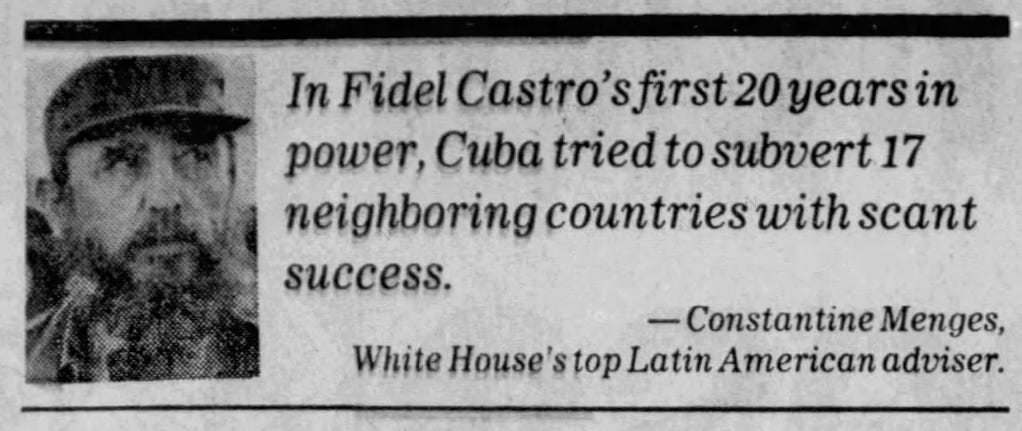
Menges personified this duality. In December 1984, just months after evaluating McLeod's appointment, he gave a revealing interview to the Miami News. Speaking at an American Enterprise Institute seminar, he listed Suriname among "seven non-democratic nations" while celebrating a "democratic wave" sweeping the hemisphere.5 "Encouraging democracy," he claimed, was Reagan's top Latin American priority. Yet even as he made these public pronouncements, documents show he was quietly vetting Suriname's diplomatic appointments through NSC channels rather than the State Department.
The timing is crucial. Duemling and North's paths had first crossed at a conference in Panama during Duemling's ambassadorship in Suriname. It was there that North had revealed his worldview to Duemling, speaking of "an extraordinary opportunity to turn Communism back around the world" in Central America, the Caribbean, and elsewhere - a vision that Duemling found "a trifle apocalyptic." It was around this time that Duemling provided his now-famous briefing to the Joint Chiefs, assessing that "200 paratroopers could take control of the capital and two military compounds" in Suriname - though he advised against invasion. Meanwhile, Project Democracy was already flowing funds to the Council for Liberation of Suriname through its public face, the National Endowment for Democracy.6
What makes Duemling's story of meeting North particularly revealing is how it illuminates Project Democracy's evolution. Originally placed in Suriname by Tom Enders with the specific mission of understanding Bouterse, Duemling was deliberately kept in the dark about Operation Guiminish when it launched on April 13, 1983. When he learned about Brazilian diplomatic activity in what he considered his territory, NSC official Alfonso Sapia-Bosch recommended to William P. Clark that Duemling be "temporarily excluded" from operations.
Yet by April 28, Clark had reconsidered. In a classified telegram to Duemling, he acknowledged the need to bring the ambassador into the fold, particularly regarding efforts to remove Cuban influence and support Brazilian initiatives.7 Clark's reversal wasn't surprising - Duemling had proven himself valuable enough to be flown to Washington to brief the Joint Chiefs about a hypothetical invasion of Suriname, where he assessed that "200 paratroopers could take control of the capital and two military compounds" while advising against such action.
Duemling's evolution from excluded observer to key player reflected Project Democracy's broader shift toward sophisticated control. He had developed a professional relationship with Brazilian Chargé d'Affaires Luiz Felipe Lampreia, even suggesting that the Brazilians be allowed to use superior American communications equipment - a proposal that would give U.S. intelligence insight into Brazilian thinking about Suriname and Cuba. By mid-1983, when he met again with North in Panama, Duemling was fully integrated into Project Democracy's parallel diplomatic and covert tracks.
The contrast between Ambassadors Duemling and McLeod reflected this evolving strategy. Duemling, a white diplomat from Fort Wayne, Indiana, had successfully built rapport with Bouterse but remained fundamentally an outsider reporting back to Washington. His careful balance between official policy and shadowy reality would later serve him well when managing North's Nicaragua operations. McLeod, who would arrive as Suriname's voice in Washington, represented something more complex: marriage ties to former President Ferrier's family, extensive European diplomatic postings, and a studied distance from Paramaribo's day-to-day politics.
After Duemling left Suriname, his career took a telling turn that illuminates how U.S. strategy was evolving. The diplomat who had won Bouterse's trust was tasked with studying the relationship between the CIA and State Department - a report that proved so valuable the CIA made it required reading for station chiefs. By September 1985, he found himself running the Nicaraguan Humanitarian Assistance Office, where he would again navigate between overt diplomacy and covert operations. This time, he was managing $27 million in humanitarian aid that Oliver North would use as cover for arms shipments.
"I was in charge of the program and it would be managed my way," Duemling later recalled telling North. "If they didn't agree with that, I asked them to tell me right then and there because then I would resign." This same independence had marked his approach in Suriname, where he balanced official policy with shadowy reality.
As we now know from the Guiminish documents, after the failure of direct intervention attempts that Duemling had witnessed in Suriname, the U.S. adopted Brazil's more sophisticated approach of controlling rather than removing problematic leaders. When Suriname proposed McLeod as their ambassador - a man who had spent years in European capitals rather than Paramaribo - NSC officials saw an opportunity. Here was someone who could serve as a bridge between Western interests and Suriname's military government, while maintaining enough distance from both to be useful.
The contrast between these two diplomats - Duemling reporting from Paramaribo to Washington, and McLeod representing Suriname in Washington - reveals how Project Democracy's approach had matured. Where Duemling represented traditional American diplomacy pushing back against covert operations, McLeod's appointment, carefully vetted by North and Menges, represented a new phase where diplomatic and covert channels could quietly merge.
The months following McLeod's formal appointment as Ambassador Extraordinary and Plenipotentiary on August 13, 1984, would test this sophisticated approach. Even as Duemling and Bouterse shared what appeared to be a warming relationship at a July 4th reception, Project Democracy's parallel tracks were evident in the documents. The same month McLeod's appointment was formalized, George Baker was meeting with Chin A Sen about overthrowing Bouterse - meetings that would later be carefully distanced from official channels when the SDP publicly offered to supply "a hundred well-trained commandos."
The October Crisis
In the Reagan Archives trove, we also find an October 1984 letter that reached the White House, posing a direct challenge to Project Democracy's commitment to maintaining sophisticated control. Written on the letterhead of the "Raad voor de Bevrijding van Suriname" (Council for the Liberation of Suriname), it came not from Paramaribo but from Rijswijk, Netherlands. Its author was Henk Chin A Sen, the former president now leading an organization openly funded by the National Endowment for Democracy. The timing was significant - just days after Suriname was quietly added to a list of countries "where U.S. involvement might occur over the next five years, which might include military support."8
The letter's routing is telling. Within days, it triggered a memo from Charles Hill to Robert McFarlane (document 97178), with Constantine Menges marked "FOR ACTION" on the NSC profile (document 8407963). These were the same officials who, just months earlier, had scrutinized McLeod's ambassadorial appointment through unconventional channels. The document's journey through the White House bureaucracy coincided with two significant shifts in policy: the passage of the second Boland Amendment restricting aid to the Contras, and Reagan's signing of the Central Intelligence Agency Information Act.
Chin A Sen's appeal was carefully crafted. It opened by reminding Reagan of Suriname's wartime contribution - "60 percent of the American need for this raw material in the aircraft industry" - before warning of "most undesirable ideologies" taking root. The Council for Liberation of Suriname, he noted, had been working since January 12, 1983 to "restore the constitutional state" and end "the violation of fundamental human rights." This timing wasn't coincidental - former CIA Director Turner had just publicly discussed "probable covert action excesses under DCI Casey," specifically mentioning operations in Suriname.
But it was his admission that "foreign support is indispensable" that most directly challenged Project Democracy's dual-track approach. Even as the Council received open NED funding and held public congresses - complete with propaganda posters showing Bouterse ripping Suriname in two - its president was now privately seeking more direct intervention.
The administration's response came through an unlikely channel. By November 1985, just over a year after Chin A Sen's appeal, another ambassadorial appointment demanded high-level attention. Arnold Theodoor Halfhide's nomination as Suriname's ambassador triggered an unusual sequence of security reviews, coinciding with the formal establishment of the "208 Committee" that would institutionalize Project Democracy's parallel tracks.
The contrast with McLeod's appointment process is striking. While McLeod's vetting had been handled quietly through NSC channels, Halfhide's appointment generated a trail of classified documents. A November 19 State Department memo (document 8534153) to McFarlane required careful routing, marked "CONFIDENTIAL" with "UNCLASSIFIED" attachments. The NSC profile (document 8509345) shows the request passed through multiple levels, with North and Burchard marked "FOR INFO" while Hughes received "FOR ACTION" status.
Halfhide's background made this scrutiny understandable. He had served as Suriname's Consul General in New York from 1981-1983 before becoming Minister Plenipotentiary in Paramaribo. More intriguingly, as Philip Hughes noted in his November 27 memo to McFarlane, he had "been associated with major timber enterprise in Suriname and a Surinamese business in The Netherlands." The attention to his commercial connections came just as the newly formed 208 Committee - whose members included key figures like Clair George, Michael H. Armacost, and Morton I. Abramowitz - was formalizing oversight of CIA activities in countries where they "dabbled in opposition politics."
This commercial connection may explain why his appointment required presidential review. The December 5, 1985 National Security Council memorandum (document 9345) shows William F. Martin informing Nicholas Platt that "The President has reviewed and concurs in the recommendation." For an ambassadorial appointment to require such high-level attention was extraordinary, but it reflected the 208 Committee's new formalized approach to coordinating overt and covert operations.
The timing of these documents - Chin A Sen's October 1984 appeal followed by Halfhide's careful vetting throughout late 1985 - reveals Project Democracy's struggle to maintain its sophisticated control strategy. Even as the Council for Liberation of Suriname sought direct intervention, the administration was scrutinizing Suriname's choice of ambassador through classified channels while maintaining public distance.
Oliver North's inclusion on the NSC routing slip is particularly telling. By late 1985, North was deeply involved in running the Nicaraguan Humanitarian Assistance Office - the same operation where Robert Duemling would manage $27 million in humanitarian aid that became cover for arms shipments. Yet here he was, still being kept informed about Suriname's diplomatic appointments. This wasn't routine procedure; NSC staffers focused on military and intelligence operations normally wouldn't be copied on ambassadorial approvals. His continued involvement suggests that Project Democracy saw no real separation between diplomatic channels and covert operations - they were simply different tools for achieving the same objectives.
This tension between overt and covert approaches, between diplomatic process and direct action, would define Project Democracy's final phase. The careful paper trail surrounding Halfhide's appointment shows an administration still committed to working through official channels, even as parallel structures operated in the shadows. North's presence on these diplomatic documents, even in an informational capacity, reveals how thoroughly Project Democracy had blurred the lines between diplomacy and covert action.
The true significance of these documents emerged months later. A 1986 Washington Post exposé would list Suriname alongside Ethiopia and Mauritius as countries where the CIA "dabbled in opposition politics" - exactly the kind of activities the newly formed 208 Committee was meant to coordinate. The committee's informal operating style - no written records kept, decisions made by consensus - helped obscure these connections. But the paper trail from McLeod to Halfhide shows how Project Democracy's architects had already perfected the art of working through official channels while maintaining covert capabilities.
Following the Paper Trail: The Proof of Project Democracy
What we've uncovered isn't just another piece of the puzzle - it's the proof that ties everything together. Three key documents, hidden in plain sight at the Reagan Library, finally confirm what we've long suspected: Suriname wasn't just another troubled Latin American nation in the 1980s. It was a testing ground for Project Democracy's full spectrum of operations, managed by the very architects of Iran-Contra.
The evidence forms an irrefutable chain:
First, Constantine Menges's January 20, 1983 memo identifying Suriname as an "urgent need" for Project Democracy. At the time, it seemed like standard Cold War planning. Now we know it was the blueprint.
Then, the stunning NSC routing slip showing Oliver North and Menges personally vetting Donald McLeod's ambassadorial appointment in April 1984. This wasn't routine diplomatic procedure - these were Iran-Contra's future architects scrutinizing Suriname's choice of ambassador.
Finally, the paper trail surrounding Chin A Sen's October 1984 letter to Reagan and Halfhide's subsequent appointment. The same players - North, McFarlane, Menges - managing both diplomatic appointments and covert operations, all through NSC channels rather than normal State Department procedures.
These documents reveal Project Democracy's true sophistication. While the Council for Liberation of Suriname received public NED funding, McLeod's strategic appointment was being quietly managed through classified channels. When that careful diplomacy faltered, Chin A Sen's direct appeal to Reagan triggered another round of NSC scrutiny over Halfhide's appointment, with North still copied "FOR INFO" even as he managed Nicaragua operations.
What emerges isn't just evidence of American involvement in Suriname - it's proof of how Project Democracy operated at its highest levels. The same figures who would later become infamous for Iran-Contra were developing their methods here: sophisticated control through diplomatic channels backed by the constant threat of direct action, all managed through parallel overt and covert structures.
This wasn't just about Suriname. What started here with Operation Guiminish - using Brazilian-style control rather than direct intervention, coordinating overt diplomacy with covert operations - became the template. By 1985, we see the same playbook deployed in Nicaragua, where Duemling would manage humanitarian aid that became cover for North's arms shipments.
Full Circle: The Evolution of American Intervention
There's a certain poetry to how this story has come full circle. On Christmas Eve 2024, as Russia waged war in Ukraine, Desi Bouterse died in hiding, and these documents landed in my inbox, I was finishing an article about a failed Christmas coup from four decades ago. But what these routing slips and diplomatic cables reveal isn't just about one operation - they show us the blueprint for what came next.
Operation Guiminish wasn't the end of American intervention in Suriname; it was the beginning of something more complex. By 1985, while McLeod was navigating diplomatic channels in Washington and Halfhide's appointment was being vetted by North and McFarlane, another Project Democracy-style operation was taking shape. Tommy Lynn Denley and 300 Miskito Indians would back Ronnie Brunswijk in what looked like a replay of Nicaragua's playbook. When that failed, the CIA-backed ANSUS Foundation and George Baker recruited more mercenaries. Dr. John resurfaced to provide intelligence, and Frank Castro exported his Nicaragua drug-running operations to Suriname.
The routing slips and diplomatic cables do more than just connect North, Menges, and McFarlane to Surinamese affairs. They provide documentary proof of how Project Democracy actually operated: scrutinizing ambassadorial appointments through NSC channels, coordinating public NED funding with private mercenary operations, managing parallel diplomatic and covert tracks - all through the same small group of officials who would later emerge at the center of Iran-Contra.
These weren't random interventions or disconnected operations. When Tommy Lynn Denley planned to lead 300 Miskito Indians to back Brunswijk, when the ANSUS Foundation recruited mercenaries, when Dr. John resurfaced and Frank Castro exported his Nicaragua playbook - these weren't just echoes of Operation Guiminish. The documents show they were variations on a template, refined in Suriname and replicated across Latin America, all managed through the same networks these routing slips expose.
Some will call Project Democracy an abject failure, pointing to the devastation left in its wake. Others, noting the ultimate collapse of communist influence in the region, might argue it succeeded through death by a thousand papercuts. But these documents reveal something far more disturbing: a deliberate subversion of American democracy carried out in democracy's name. Even as Congress passed two Boland Amendments explicitly forbidding these activities, Project Democracy's architects - convinced they knew better, certain God was on their side - built parallel structures to circumvent the law. They lied to congressional investigators, spread propaganda through religious networks, and created a shadow foreign policy apparatus - all because they saw the world in stark absolutes of good versus godless communism. This wasn't just about sophisticated control versus direct intervention; it was about a small group of officials deciding they had the right to override democratic processes in the name of defending democracy itself. The networks and methods they created didn't just outlive the Cold War - they fundamentally changed how American power could operate in defiance of its own democratic principles.
As I write this on Christmas Day 2024, with Bouterse dead and these NSC routing slips finally seeing light, I can't help but wonder about the true cost of these operations. The evidence was always there in the bureaucratic paperwork - we just had to connect Menges's "urgent need" memo to North's scrutiny of ambassadors, to trace McFarlane's management of parallel diplomatic and covert tracks. Next season, we'll explore how these same networks - built by Project Democracy's architects and documented in these papers - would transform Suriname into a crucial hub for drugs and arms, showing how the sophisticated tools developed to fight communism created something perhaps even more dangerous in its place.
Kornbluh, Peter, and Malcolm Byrne. The Iran-Contra Scandal : The Declassified History. New York : New Press : Distributed by W.W. Norton, 1993. http://archive.org/details/irancontrascanda00korn.
“Foreign Relations of the United States, 1981–1988, Volume I, Foundations of Foreign Policy - Office of the Historian,” November 30, 1983. https://history.state.gov/historicaldocuments/frus1981-88v01/d176.
The New York Times. “SURINAME SAYS IT FOILED COUP AND SEIZED 10 PARAMARIBO,.” November 30, 1983, sec. World. https://www.nytimes.com/1983/11/30/world/suriname-says-it-foiled-coup-seized-10-paramaribo-suriname-nov-29-ap-left-wing.html.
Logan Herald Journal. “Logan Herald Journal, Nov 29, 1983, p. 2 | NewspaperArchive.” November 29, 1983. https://newspaperarchive.com/logan-herald-journal-nov-29-1983-p-2/.
The Miami News. “U.S. Official Says Castro Can’t Stop Democracy.” December 6, 1984. https://www.newspapers.com/article/the-miami-news-us-official-says-castro/161679958/
Duemling, Ambassador Robert W. “Interview with Robert W. Duemling.” The Association for Diplomatic Studies and Training Foreign Affairs Oral History Projec, September 11, 1989. 39-44. https://memory.loc.gov/service/mss/mfdip/2004/2004due01/2004due01.pdf.
Naarendorp, Frank, and Dennis E. Levens. “‘OPERATIE GUIMINISH,’” October 2022.
CIA.gov. “SUPPORT TO US MILITARY FORCES. NIE 7-84, THE OUTLOOK FOR SUDDEN CHANGE IN KEY DEVELOPING COUNTRIES | CIA FOIA (Foia.Cia.Gov).” Freedom of Information Act Electronic Reading Room, October 16, 1984. https://www.cia.gov/readingroom/document/cia-rdp87t00472r000200310011-8.
Sources
Diplomatic Records
National Security Council. "NSC/S Profile: Appointment of Donald McLeod as Ambassador to US." Ronald Reagan Presidential Library, WHORM Subject File CO149 (Suriname), Document ID 8403080, April 13, 1984.
Fackelman, Pete. "President Reagan and Ambassador Donald McLeod." Ronald Reagan Presidential Library, White House Photo Collection, C23955(01), August 29, 1984. https://www.reaganlibrary.gov/archives/photo/c23955-01
Fackelman, Pete. "President Reagan and Ambassador Donald McLeod." Ronald Reagan Presidential Library, White House Photo Collection, C23958 (01), August 29, 1984. https://www.reaganlibrary.gov/archives/photo/c23958-01
Organization of American States. "Second Report on the Human Rights Situation in Suriname." Inter-American Commission on Human Rights, October 2, 1985.
Contemporary Press and Government Documents
"The Bulletin of the European Communities Reports on the Activities of the Commission and the Other Community Institutions." No. 2, Vol. 22 (1989).
McLeod, Donald A. "Foreign Embassies in the U.S. and Their Ambassadors." U.S. Department of State, Diplomatic Representation for Suriname (2011).
"Regels Buitenlandse Dienst Waren Wel Aanwezig." De West, November 21, 2018, Lokaal section.
Biographical Sources
"Cynthia McLeod." In Portal:Suriname/Selected Biography. Wikipedia, June 10, 2020.
"List of Ambassadors of Suriname to the United States." Wikipedia, December 25, 2024.
"2009 Authors." CABAFAIR. Accessed December 27, 2024.
Daily News. “Academy of Armed Services New York.” November 17, 1980.
NAME: DONALD ALOYSIUS MCLEOD
DATE OF BIRTH: DECEMBER 3, 1934
PLACE OF BIRTH: CURACAO N.A.
MARITAL STATUS: MARRIED — 3 CHILDREN
NATIONALITY: SURINAMESE
Educational Background:
1941-1952:
Primary and Junior High Education at St. Thomas College, Curaçao, Netherlands Antilles.
1952-1955:
Preparatory Higher Education at St. Odulphus Lyceum, Tilburg, Netherlands.
1955-1959:
Student in Social Sciences, Economics, Sociology, History, and Cultural Anthropology at the University of Leyden, Faculty of Letters and Philosophy.
1959 (May):
Received Bachelor's Degree in Social Sciences ("Candidatus").
1959 (May-December):
Field Study: Adaptation of Rural Workers (Colonos) in the Badajoz Irrigation Scheme, Spain, through the Institute of Colonization.
1960-1961:
Returned to the University of Leyden for postgraduate studies:
Major: Sociology of Developing (Non-Western) Countries, with specialization in Latin America and the Caribbean.
Second Major: Economics of Developing Countries.
Professional Experience:
1961 (September-March 1962):
Practical training and job study sponsored by the Government of Suriname at the Ministries of Social Affairs, Labour, Education, Culture, and Welfare in The Hague, Netherlands.
1962 (March 16):
Employed as a Social Science Researcher at the Ministry of Social Affairs and Labour, Paramaribo, Suriname.
1963-1964:
Fellowship training with the OECD in Paris as part of the Mediterranean Programme, specializing in Human Resources and Educational Planning.
1964-1967 (August):
Returned to Suriname to work as Senior Social Science Researcher at the Ministry of Social and Labour Affairs.
1967:
Nominated as Adjunct General Director of the Ministry of Labour and Social Affairs.
1975 (August 15 – September 30, 1975)
Pending the Independence of the Republic of Suriname; on instructions of the Suriname Government, participation in the “special course for future Suriname Diplomants” organized by the Institute of Social Studies, with the cooperation of the Netherlands Ministry of Foreign Affairs and the Netherlands Institute of International Affairs
1978-1978:
Director-General of the Ministry of Labour and Housing.
President of the Statutory Council of the Surinamese Volkscrediet Bank (People's Credit and Savings Bank).
Part-time lecturer in Sociology at the University of Suriname Faculty of Law.
1978 (November) - 1981 (October):
Accredited as Ambassador Extraordinary and Plenipotentiary of the Republic of Suriname to Venezuela.
1981 (October) - 1982 (October):
Employed at the Ministry of Justice and Foreign Affairs in Suriname, heading the Research Division for International Technical and Economic Cooperation.
1982 (October) to present
Accredited as Ambassador Extraordinary and Plenipotentiary to the Kingdom of Belgium
1982 (December) to Present
Accredited as Ambassador Extraordinary and Plenipotentiary to the Kingdom of France
1983 (January) to Present
Accredited as Head of Permanent Mission (Delegation) to the European Communities (European Commission and Council of Ministers)
1983 (September) to Present
Accredited as Head of Permanent Delegation to Unesco